
Many parents assume orthodontics begins when a teenager is ready for braces.
In reality, an orthodontist can learn a great deal about a child’s developing teeth and jaws years before all of the permanent teeth have arrived.
The American Association of Orthodontists recommends that children receive their first orthodontic check-up no later than age 7. At that age, children typically have a combination of baby teeth and permanent teeth, allowing an orthodontist to evaluate how the bite, teeth, and jaws are developing.
That does not mean every seven-year-old needs braces.
For many children, the first visit simply establishes a baseline so development can be monitored over time.
Why Is Age 7 Important for an Orthodontic Evaluation?
Around age 7, several permanent teeth have usually begun to erupt while the face and jaws are still developing.
That gives an orthodontist an opportunity to look for concerns that may not be obvious when a parent looks at a child’s smile.
An early evaluation can help identify developing problems involving:
- Crowding
- Tooth spacing
- Crossbites
- Underbites
- Overbites
- Teeth erupting in unusual positions
- Missing or extra teeth
- Jaw-development concerns
The AAO emphasizes that an orthodontic check-up and orthodontic treatment are two different things. Only some children require treatment at an early age. Others may simply be monitored until the timing is appropriate.
What Signs Might Mean My Child Should See an Orthodontist?
You do not have to wait until your child’s teeth look obviously crooked.
Some signs that may warrant an orthodontic evaluation include:
Crowded Teeth
Crowding occurs when there is not enough room for teeth to erupt into their ideal positions.
Sometimes crowding is obvious. In other cases, an orthodontist can identify developing space problems before all of the permanent teeth appear.
Crossbite
A crossbite occurs when certain upper teeth bite inside the lower teeth rather than outside them.
Because some bite relationships involve jaw development as well as tooth position, early evaluation can be helpful.
Underbite
An underbite occurs when the lower front teeth sit ahead of the upper front teeth when the mouth is closed.
The relationship between the upper and lower jaws may be an important part of determining the appropriate treatment and timing.
Difficulty Chewing or Biting
A child’s teeth should work together effectively when chewing.
Problems with the way the upper and lower teeth meet can sometimes make biting or chewing more difficult. The AAO includes chewing problems and abnormal bite relationships among signs that may warrant orthodontic evaluation.
Unusual Loss or Eruption of Teeth
Baby teeth that are lost unusually early or late, or permanent teeth that appear to be erupting in unexpected positions, can affect how the rest of the smile develops.
An orthodontist can evaluate the available space and eruption pattern.
Protruding Front Teeth
Front teeth that extend farther forward may be more vulnerable to injury.
An orthodontic evaluation can help determine whether treatment or monitoring is appropriate.
Does an Orthodontic Evaluation at Age 7 Mean My Child Will Get Braces?
Usually, no.
The purpose of an early orthodontic visit is to evaluate development, not to automatically begin treatment.
The orthodontist may determine that:
- Everything is developing normally
- A condition should be monitored
- Treatment may be helpful later
- Early treatment may be appropriate for a specific problem
The AAO notes that only a limited number of orthodontic problems need correction around age 7, and early treatment does not always involve braces.
For many families, the most valuable outcome of the first visit is simply knowing what to expect.
What Is Phase I Orthodontic Treatment?
When orthodontic treatment is recommended while a child still has a mixture of baby and permanent teeth, it is often called Phase I or interceptive orthodontic treatment.
Caspian Dental Center’s Phase I orthodontic program generally focuses on children during the mixed-dentition years and may address concerns such as narrow dental arches, crossbites, underbites, crowding, oral habits, or early loss of baby teeth.
The purpose of Phase I treatment is not simply to make teeth look straighter at a younger age.
When clinically appropriate, early treatment may help an orthodontist guide developing teeth or jaws while a child is still growing.
What Types of Appliances Can Be Used During Early Orthodontic Treatment?
The exact treatment depends entirely on the child’s diagnosis.
Depending on the orthodontic problem, treatment may involve appliances such as:
- Palatal expanders
- Partial braces
- Space maintainers
- Other orthodontic appliances selected for the child’s individual needs
Caspian’s Phase I service includes these types of age-appropriate orthodontic options when indicated.
An evaluation is necessary before determining whether an appliance is appropriate.
What Does a Palatal Expander Do?
A palatal expander is an orthodontic appliance that may be used in certain growing children when the upper jaw or dental arch is too narrow.
Because children are still developing, orthodontists can sometimes use growth to help address specific jaw-width or bite concerns.
The AAO notes that palatal expansion may be useful for selected growing patients with narrow upper arches and related orthodontic problems.
Not every child with crowding needs an expander, so treatment should be based on an orthodontic examination rather than appearance alone.
What Happens After Phase I Treatment?
Some children who complete Phase I treatment later move into another stage of orthodontic care after more permanent teeth have erupted.
This is commonly referred to as Phase II treatment.
Phase II may involve braces, clear aligners, or another orthodontic approach depending on the patient’s needs.
Other children may require little or no additional treatment.
The important point is that early evaluation allows the orthodontist to create a plan based on development rather than waiting until every permanent tooth has erupted before identifying a problem.
What Happens During My Child’s First Orthodontic Visit?
The first visit is primarily about gathering information.
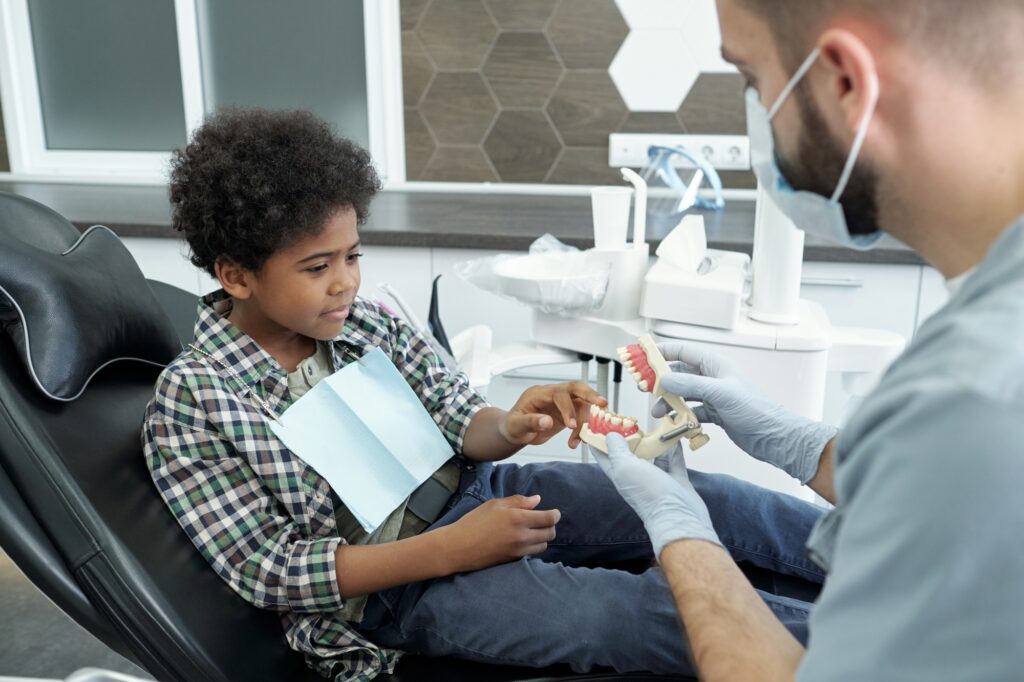
The orthodontist will evaluate the child’s teeth, bite, and jaw development and discuss any concerns with the parent.
According to the AAO, a first orthodontic examination generally helps answer several basic questions:
- Is there an orthodontic problem?
- What options are available?
- Is treatment needed now or later?
- What might treatment involve?
- How long might treatment take?
Additional diagnostic information may be recommended depending on the child and the findings of the examination.
Why See an Orthodontist for Your Child’s Bite and Jaw Development?
Orthodontists receive advanced specialty training after dental school in the diagnosis, prevention, and treatment of tooth-alignment and jaw-development problems.
At Caspian Dental Center, orthodontic care is provided by Dr. Diaa Allahham, an American board-certified orthodontist who completed specialty training in Orthodontics and Dentofacial Orthopedics and earned a master’s degree in Oral Science in Clinical and Translational Sciences through the University of Rochester.
Caspian offers orthodontic services that include children’s Phase I orthodontics, braces, clear aligners, retainers, dentofacial orthopedics, and additional treatment options based on individual needs.
Frequently Asked Questions About Children’s Orthodontics
Should my child see an orthodontist even if their teeth look straight?
It can still be worthwhile. Some orthodontic concerns involve the bite, eruption of permanent teeth, or jaw relationships that may not be obvious simply by looking at the front teeth.
Is age 7 too young for braces?
An evaluation by age 7 does not mean braces will begin at age 7. The AAO recommends the early check-up so an orthodontist can identify developing concerns and determine the appropriate timing if treatment is ever needed.
What if my child is already older than 7?
It is not too late. Children and teenagers can still benefit from an orthodontic evaluation even if they did not have one at age 7.
Will my child definitely need two phases of treatment?
No. Two-phase treatment is appropriate only for certain orthodontic conditions. An orthodontist can determine whether early treatment offers a meaningful benefit or whether monitoring is the better choice.
Can early orthodontic care prevent braces later?
Not necessarily. Phase I treatment and later comprehensive orthodontic treatment serve different purposes. Some children may still benefit from braces or clear aligners after additional permanent teeth have erupted.
Children’s Orthodontics in Katy, TX
An early orthodontic visit is less about putting braces on a young child and more about understanding how the smile is developing while there is still time to monitor growth and choose the right treatment timing.
If your child is approaching age 7, has never received an orthodontic evaluation, or you have concerns about crowding, bite alignment, or jaw development, Caspian Dental Center can evaluate your child’s needs and discuss appropriate options.
Caspian Dental Center is located at 410 Park Grove Dr., Katy, TX 77450.
Call (832) 321-4901 to schedule an orthodontic consultation.
This article provides general educational information and is not a diagnosis or a substitute for individualized dental or orthodontic advice.